

Medical Foot Switch and Foot Pedal Design: What the Operating Environment Demands
Medical foot switches and foot pedals perform under demanding operational conditions.
Users may be working without direct visual focus, from constrained positions, and across repeated cycles where consistency and reliability are not optional. These conditions affect whether the control performs as the user needs it to.
They are also difficult to express fully in a specification written before the control has been designed. PRESPEC by Linemaster is a formal design phase development program that brings these conditions into development while the design can still respond to them.
TL;DR
Operation Without Direct Visual Attention
Medical foot switches and foot pedals are often operated without direct visual attention. Clinicians may be focused on the patient, the procedural field, or the primary equipment interface while locating and actuating the control by feel.
This places specific demands on the design. Tactile differentiation between functions should be clear when the user is not looking down, and resistance to unintended activation becomes equally important. A user who cannot see the control needs to identify and actuate the intended function without confirming it visually and without triggering an adjacent function through a shifting foot position.
Pedal geometry, force, travel, spacing, and tactile response should therefore be evaluated together rather than specified independently.

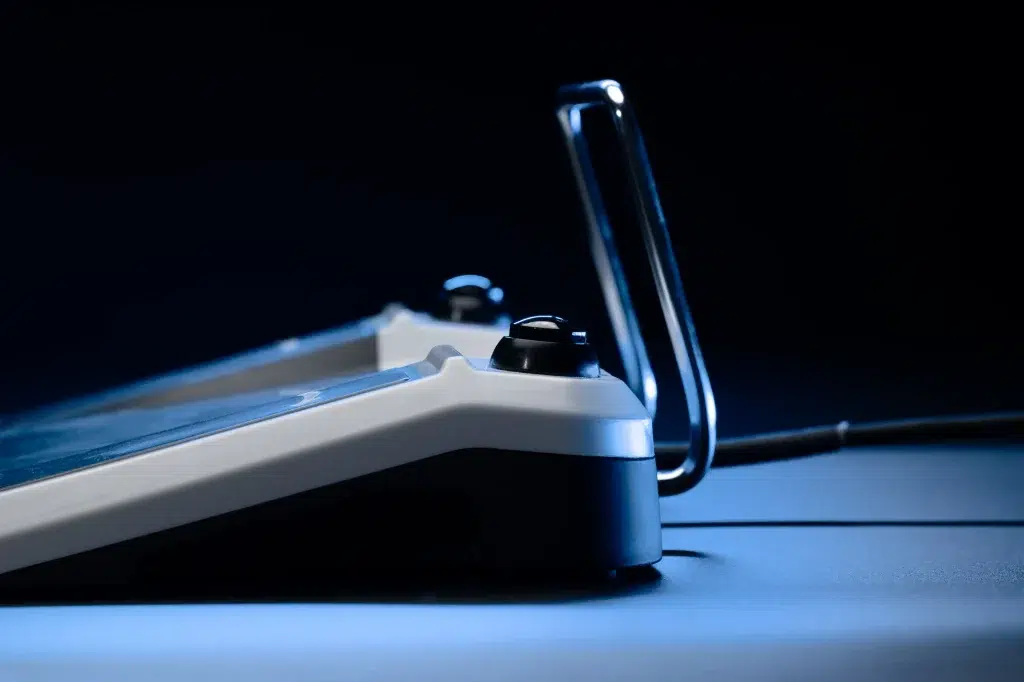
For foot operated controls, relevant design considerations include:
Posture, Movement, and Force Distribution in Foot Operated Controls
Posture, movement, force distribution, spacing, and tactile feedback are not optional refinements. They influence how the control performs across a full procedure.
Excessive dorsiflexion or plantar flexion can contribute to discomfort and fatigue. Repeated ankle inversion or eversion, lateral reaching, and sustained leg positioning can also increase physical demand during longer procedures.
Users may operate controls while wearing different types of footwear, working from constrained or asymmetrical positions, or maintaining a posture for an extended procedure.
The control should support natural foot placement and efficient movement while allowing the user to identify and actuate the intended function without looking down.
Cleanability and Material Compatibility for Medical Controls
Medical controls may be exposed to fluids, repeated cleaning, and the disinfecting agents specified by the OEM. Cleanability should therefore be treated as a design input rather than a final appearance consideration.
Materials, surface finishes, labels, seams, recesses, fasteners, seal interfaces, and transitions between components should all be evaluated for compatibility with the intended cleaning process.
Cleaning agent exposure can affect polymers, adhesives, printed graphics, cable jackets, coatings, and elastomeric seals. These interactions should be evaluated during material selection and verified under representative exposure conditions.
Cleanability considerations can also influence ingress protection requirements as well as enclosure and sealing strategy selection.

The design should provide accessible surfaces, minimize debris traps, and reduce unnecessary crevices while maintaining:
The Limits of a Written Specification
A specification can state an actuation force, a travel distance, or an ingress protection rating. It is less able to describe how those values behave together under the conditions the control will face, or how a user working by feel may encounter difficulty.
Evaluation findings can be incorporated into successive design revisions before the product architecture is finalized.
When applicable, these activities can support the OEM’s human factors engineering and usability engineering process under IEC 62366-1. Linemaster’s work provides control specific development inputs, while the OEM remains responsible for the usability engineering process for the complete medical device.
Through PRESPEC, these questions can be evaluated directly rather than predicted from specifications or computer models. Early mockups, rapid prototypes, and functional prototypes allow development teams to evaluate:

Design Phase Development for Demanding Medical Environments
Medical environments place demands on foot switches and foot pedals that a written specification cannot fully express. These include operation without direct visual attention, tactile differentiation between functions, posture and force distribution across extended procedures, and material durability under fluid exposure and repeated cleaning.
PRESPEC by Linemaster is a design phase development program for custom medical foot switches and foot pedals that brings these considerations into development while the design can still respond to them. Ergonomics, human factors, cleanability, and environmental performance are addressed as connected design inputs rather than separate late stage corrections.
Frequently Asked Questions
Why are medical foot switches often designed for operation without looking down?
Clinicians may be focused on the patient, the procedural field, or the primary equipment interface while locating and actuating the control by feel. Tactile differentiation between functions and resistance to unintended activation therefore become significant design considerations.
What ergonomic factors affect medical foot pedal design?
Relevant considerations include pedal height, pedal spacing, actuation force, pedal travel, foot placement, stability, tactile differentiation, lateral reach, required leg movement, and resistance to unintended activation. Excessive dorsiflexion or plantar flexion, repeated ankle inversion or eversion, lateral reaching, and sustained leg positioning can increase physical demand during longer procedures.
How does cleaning affect medical control materials?
Cleaning agent exposure can affect polymers, adhesives, printed graphics, cable jackets, coatings, and elastomeric seals. These interactions should be evaluated during material selection and verified under representative exposure conditions. They can also influence ingress protection requirements and the selection of an enclosure and sealing strategy.
Why is a specification alone often insufficient for control design?
A specification can define individual values such as actuation force, travel, or ingress protection rating, but it is less able to describe how those values behave together under representative operating conditions. Iterative prototyping allows geometry, reach, force, travel, tactile feedback, and potential use errors to be evaluated directly before the product architecture is finalized.
Meet The Author

Arijan Kandic
Digital Marketing Specialist
Arijan is the Digital Marketing Specialist at Linemaster Switch Corporation and holds a bachelor’s degree in business management from Quinnipiac University. He manages the company’s SEO strategy, Google Ads campaigns, and digital marketing initiatives, and develops educational content for the Linemaster Learning Center to help engineers, OEMs, and medical device manufacturers better understand foot switch technology. Arijan works closely with Linemaster’s engineering and applications teams to translate complex technical concepts into clear, accurate articles on foot switch design, customization, and compliance considerations.
In Collaboration with

Sean Lewis
Director of Engineering
Sean has more than fifteen years of experience in product development, engineering governance, and cross functional technical operations. His background in metal fabrication, including machining, forming, welding, and inspection, provides a strong manufacturing foundation that supports his approach to design and process optimization. Sean holds a bachelor’s degree in mechanical engineering, an MBA with a manufacturing concentration, and an MSOL. He is a Certified SolidWorks Expert with advanced capability in CAD, rendering, simulation, and rapid prototyping. Sean also specializes in DFMEA and PFMEA risk management practices and is the holder of several foot switch design and utility patents.
Updated 10/26/2026
Custom Foot Switches
Linemaster’s custom footswitches are designed to meet specific user requirements, offering a range of features such as various pedal configurations, wired and wireless options, and customizable LED indicators. These custom footswitches provide reliable, durable solutions tailored to enhance functionality in diverse applications.

